Navigation
Friday
Dec232011

In Loving Memory of William J. Geiszler ("Grandpa the Great")

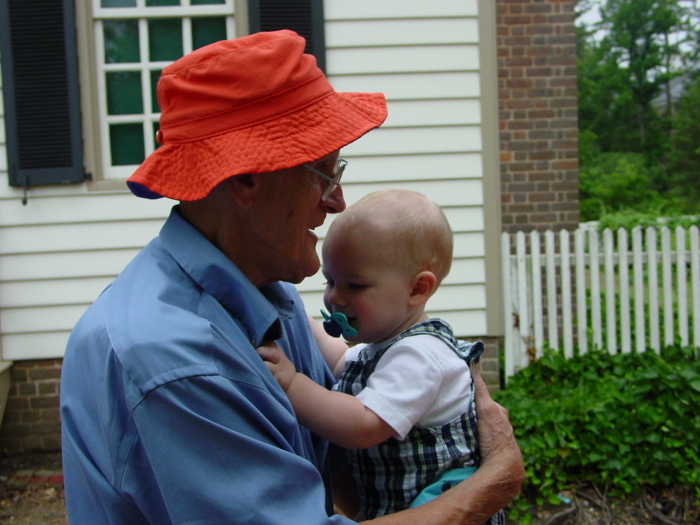
William J. Geiszler with his Great Grandson, Williambsurg Virginia 2004

If you never had the privilege of meeting William J. Geiszler, don't worry he we was making his way around to you. To say he never met a stranger seems a silly understatement. When I started dating my wife almost an entire span between birth and a driver's license ago, Bill was a silent presence in the back of the room, living only to care for his ailing wife. Then Rosemary died and he was like a yellow dwarf star that just started expanding in presence and spirit to this red giant that filled all rooms and outdoor venues where you found him in attendance.

I must have listened to each of his stories a hundred times; he had them on a mental iPod playlist that he assigned to the people he met and loved. If you were being called to listen to a rerun of one of Bill's stories, you should have considered it an honor because it meant he liked you. He started dating again and not just dating but actively juggling multiple "friends" as he used to call them. He fell in love and lost another partner to untimely passing and that shook him up so much that he never got so arrogant as to use the word commitment past his 85th year. But he still had love in his heart for his family, his Catholic faith, for his native city of Columbus Ohio and for the great institution of Ohio State Football in that order.

Bill was a World War II Veteran and he'd often thrown in a few little tidbit stories in his repotoire. As soon as I'd walk into a family gathering, he would grab my elbow, pull me aside and take me on a journey through his life. Eventually he began bringing props--photos, journals, newspaper clippings, whatever he could find to aid his presentation. And his stories got better through the years and he started telling them more often when he realized that people actually wanted to listen to him tell them. The narrative of Bill's stories could not have been stripped of his telling them and remained as effective as they were any more than the body could be stripped of the spirit and still rise to ambulate.

In 2008 Bill approached me about wanting to write his memoir from The War. I had been begging him for years to put a pen to paper so he could leave a legacy to his great granchildren who would never understand from an adult perspective how good a man he was and how lucky we were to have him in our lives. To be honest, I never thought he would give his energy to the project but I was wrong. Bill came to me two months later with copy. The next month, he'd shed the notebook and pen because  his hands shook too much and hurt for days after trying to write. Now he had a binder full of typed copy and audiotapes which I spent many nights and weekends over the next several months transcribing into a manuscript. He brought photos and documents that I placed within the narrative structure. He had taken up a volunteer position with the Columbus Ohio Honor Flight after his amazing trip with them to Washington D.C. where he met General Colin Powell and charmed the heart of a young and beautiful Lieutenant assigned to escort the group. And he wanted to talk about that too.

By the Fall of 2010, the manuscript was proofed, completed and we were just about to put the order in for printing when my son's Elementary School invited Bill to speak for Veteran's Day. He created his own special playlist for that one. The Children were fascinated by him, an old man who still approached life with the same wonder many of them felt in their hearts, the same wonder many of them likely no longer saw in the eyes of the adults they dealt with--Grandpa was an anomoly like that. And of course,  he wanted to include that experience as part of the book. So, we went back to the manuscript and added a final chapter, what became in my opinion the perfect ending to the story Bill wanted to tell the world.

There were many stories he held back from us though, from his younger days before the war, mysteries about his father's death near a railroad track that almost nobody alive knows the full story behind. And there were stories after the war, behavior he wasn't proud of, mild by today's tabloid standards yet still unbecoming a soldier of the United States Army in Bill's mind. But he had his moment of clarity and he made his choice, the right choice, to assume the title of Grandpa the Great, a moniker the entire family gladly took to calling him, mostly because it was true.

The loss of William Geiszler, three days before Christmas in 2011, has sent all of us who knew him reeling as if we were walking down the stairs and the bannister suddenly fell away during our descent. I don't like to think about gathering for Christmas without Bill, waiting for a firm finger that will never again tap me on the shoulder to call me away into the sunny sitting room he always liked to hold court inside when he told his stories.

I'm not even sure how I would have said goodbye to Bill if I'd have had the chance but I have had the ending of A Christmas Carol going through my mind since I was told of his passing and I'd like to paraphrase the great Dickens in honor of Grandpa the Great:

[He] was better than his word. He did it all, and infinitely more...He became as good a friend, as good a master, and as good a man, as the good old city knew, or any other good old city, town, or borough, in the good old world...for he was wise enough to know that nothing ever happened on this globe, for good, at which some people did not have their fill of laughter in the outset; and knowing that such as these would be blind anyway, he thought it quite as well that they should wrinkle up their eyes in grins, as have the malady in less attractive forms. His own heart laughed: and that was quite enough for him.

Goodbye Grandpa the Great, you were an inspiration to us all for how to grow old with grace and laughter and true friendship.


William J. Geiszler died at the age of 89 years old. He loved and was loved. If you'd like to purchase a copy of Bill's book "Just Bill" CLICK HERE FOR EBOOK or CLICK HERE FOR PAPERBACK

Thursday
Dec082011

If Your CRM is an Administrative Burden to Your Sales Team, You Have No Business Using One

Seriously, cancel your subscription now. If your sales professionals are entering opportunities after they are already won and are not entering opportunities that are closed lost then you are missing the point. The purpose of a Sales CRM is to help sales professional and sales management manage the process of selling something to people who may be unsure about buying it and then providing data back to the business that can be used to mitigate obstacles in future opportunities.

It sounds simple when it's all on paper but getting human capital to move in one smooth motion toward a common goal is the reason management was invented in the first place and it's damn hard to do. Ask anyone who has ever rowed crew.

If your CRM has become a battlefield of administrative landmines with no return on information value, then you either need to scrap the program and go back to spreadsheets and emails or you need to take six months and plan out an execution strategy that approaches your process and the system it uses from all angles to make sure that you will be working through deals instead of pretending like you're doing something meaningful with your expensive shiny rolodex.

Monday
Nov282011

5 Reasons to Love 11/22/63 by Stephen King

Joshua Minton and Stephen King at the Sarasota Book Signing for 11/22/63. November 2011. [CLICK for larger image]

Stephen King has nothing to prove--he's done it all but he keeps delivering these knockout blows that really just add new peaks to the mountaintop of literary accomplishments. But this book, above all the others, will ensure his name is known as one of the greatest authors America ever produced. So enough kissing his ass already; here are five reasons you should read this book.

5. METICULOUS RESEARCH, EXPERTLY CONVEYED: King did serious homework for this book which included travel and electronic back and forth with experts. He read dozens of books and the details pour off the page in a narrative that never slows down despite truckloads of information and logistics. Just astoundingly impressive!

4. GREAT AMERICAN THEMES: King is tapping into the best literature in the history of human art here. 

  • LOVE CONQUERS ALL? Check 
  • YOU'RE BETTER OFF WHERE YOU STARTED? Check
  • INDIVIDUALS CAN CHANGE THE WORLD WITH LOVE AND COMPASSION? Check
  • HEROES CAN BE GEEKY DUDES WHO NOBODY REALLY LOVES? Check

3. DARK TOWER TIE-IN?: This is kind of a given because all of King's stories, whather subtle or overt, have a tie in to the Dark Tower; it's the will of KA after all. But 11/22/63 introduces an interesting character in the [INSERT COLOR] Card Man who stand watch over these time portals, harrassing time travellers. They are logisticians of a sort who must keep the separate strands of time in focus or bad (very bad) things can happen. In the Dark Tower series, the Crimson King employs Breakers whose job is to focus psychic energy to break the beams of the Dark Tower and destroy all of existence. The Color Card Men seem to be night watchmen, charged with preventing misdemeanor tampering of the strands of existence. Sound far out? Keep in mind, Stephen King is the author who wrote himself into his own book during the Dark Tower series and he didn't wuss out and pull the Kilgore Trout stuff that Vonnegut did--he was straight up Stephen King. Also, King originally conceived the concept for this book in 1972 which means it's almost as old as the Dark Tower and Roland's quest.

2. AMAZING PLOT: This book is the story of a man who finds a singularity in 2011 that allows him to travel back in time to 1958 and spend as much time as he can only to return 2 minutes later with each trip. Long story short, the main character embarks on a crusade to stop Lee Harvey Oswald from shooting JFK on 11/22/63. This means the man must live 5 years in the past, that his body ages and he must find a way to survive and prepare until that date. Add in the not so small complication that history protects itself by blocking those who want to change it, sometimes murderously and the bigger the change, the harder it fights. Oh also, the main character falls hopelessly in love which gives history a pretty big crowbar to hit him over the head with along the way--and how does he bring that love back with him to 2011? You get the idea. This is one of hte greatest story lines every devised and King over delivers on the promise of the concept. 

1. PAYOFF!: I'm talking big time payoff here. Several times during the first 300 pages, I thought to myself how easy it would be to cheap shot the reader (e.g. the protagonist gets to the sixth floor at 12:28 and no one is there,etc.) but King drives a big machine right into your brain and out the other side. I haven't read a novel with this great of a payoff in a very long time.

<><><><><><><><><><> 

It's hard to commit to an 850 page book, I know. But if my word means anything, I highly recommend the experience. People will be talking about this book in reference to the Kennedy assassination hundreds of years from now so make sure you don't miss out. 


Monday
Nov072011

Beware of the Hidden Goal: A Lesson on Clear Communication from World War II

The Treaty of Versailles, which ended World War I, was many things but effective was not one of them. Under the ruse of securing peace through disarmament and promoting national self-determination with Wilson's 14 points, the Allies set forth to brutally punish Germany by weakening it through forced disarmament and ridiculous reparation penalties.

Adolf Hitler was also many things but naive wasn't one of them. Before executing the Anschluss that forcibly reunited Austria back into Germany, he went to the Allies with an offer to unilaterally disarm if they would divest themselves of all weapons as well. The French and British scoffed and Hitler had them. In their lie lay the foundations of the Second World War, born from the hypocricy at the heart of the Versailles Treaty.

The lie was that disarmament for peace was the purpose of the treaty. It wasn't. The purpose was to crush and keep weak, to rule, to overlord. Many companies still take this approach towards their employees and social media. The lie is that they do so in the name of protection and security. The truth is they are afraid of open and honest dialogue in the marketplace. And the truth is that this honest communication is taking place with or without their consent.

How many companies use words like collaboration and synergy in an agenda of employee support yet they turn around and block major social media collaboration tools that would accomplish these goals much easier?

The bottom line is that the Germans knew the French were lying about securing peace when Hitler pressed unilateral disarmament and employees likewise should know that companies who block Facebook and Twitter yet still talk about collaboration and synergy are full of the brown stuff that makes crops grow.

And guess what--soon their customers and prospects will find out also.

Photo by Nationaal Archief

Thursday
Nov032011

Access Versus Ownership: The Critical Battle For Business Information

By frankpierson

I pay $9.99 a month for Spotify and I don't own 95% of the music I listen to on there. But I carry that music with me on my iPhone, iPad and whatever computer I'm currently logged into. Does it matter that I don't have a hard disk or the digital rights management to sync the file to my iPod when I still have access to the music 95% of the places I go?

This question isn't just one for personal entertainment; it's a vital showdown taking place in Information Technology departments around the world. Companies like salesforce.com are convincing their customers to move their data, application development, user access and indeed whole business processes into The Cloud, where hardware and software are no longer line items to budgeted for and maintained. This is taking place right now from multi-thousand user Financial Services companies to two person private companies. Server hardware and maintenance is going the way of The Confederacy as is proprietary client-server software packages that are expensive to deploy and ridiculous drains of resources to enhance.

I recently worked on a team of ten or so people that managed a Salesforce organization of 8,000 users. Go find me an IT department that can do that with on premise client-server technology. 

The battles being fought right now in Information services are centered around access to data and digital products versus their physical ownership. If a company sides with the latter, it is going to cost them triple and take three times as long to keep up with than their competitor who chooses the former.

The needs of today should've been met yesterday and the needs for tomorrow should be working right now. Where is your company?


Joshua Minton is a salesforce.com Certified Sales & Service Cloud Consultant, Advanced Administrator and Developer. He works for The Revolution Group in Columbus Ohio.